30-Second Summary: Key Points for Choosing Caster Wheel Material
- Check load capacity first: Estimate safe load capacity based on total equipment weight, maximum load, and number of casters, to avoid overloading a single wheel.
- Then check the floor: Smooth floors (wood, tile, epoxy) suit PU or TPR wheels; rough or outdoor floors suit wear-resistant rubber or nylon wheels.
- Confirm the environment: High heat, oil, chemicals, or damp washdown environments require additional evaluation of heat resistance, oil resistance, and rust-proof brackets.
- Match the material: PU emphasizes wear resistance and low rolling effort; TPR emphasizes quiet, mark-free operation; rubber emphasizes shock absorption and slip resistance; nylon (MRC) emphasizes high load capacity and moisture resistance — choose based on actual operating conditions.
Common Caster Types: Classified by Direction of Travel and Load Rating
Before learning about caster wheel materials, you need to understand the basic types of casters to ensure the wheel configuration matches your actual operating environment and purpose.
By Direction of Travel
- Swivel casters (all-directional): Swivel freely and rotate 360 degrees, suitable for equipment that needs frequent turning, operates in narrow aisles, or has complex movement paths.
- Rigid (fixed) casters: Designed for one-directional travel, greatly improving straight-line tracking stability — suitable for long-distance handling, logistics carts, and moving industrial equipment.
- Brake casters: Use a pedal, latch, or brake structure to limit wheel rotation, reducing the risk of slippage after positioning. For higher safety needs, choose a "total-lock" structure that locks both rolling and swiveling.
By Load Rating
- Light-duty casters: For light equipment, display racks, small carts, or low-load equipment.
- Medium-duty casters: For logistics carts, warehouse equipment, workstations, tool carts, and general factory handling.
- Heavy-duty/extra-heavy-duty casters: For heavy machinery, large equipment, heavy industrial handling, automated logistics equipment, and high-frequency industrial applications, typically with higher load capacity, bracket rigidity, and structural strength.
Common Wheel Material Comparison: Properties of PU, TPR, Rubber, and Nylon Casters
Caster wheel material directly affects a machine's load capacity, rolling resistance, operating noise, wear resistance, floor protection, and service life. When selecting, you should evaluate equipment load, floor conditions, handling frequency, and environmental requirements together to ensure equipment moves safely and meets your needs. Below are 4 common caster wheel materials:
1. Polyurethane Wheels (PU)
Polyurethane (PU) wheels offer good wear resistance, high load capacity, and low rolling resistance — compared with general rubber wheels, they're better suited to medium-to-high-frequency industrial handling, and are commonly found on warehousing/logistics carts, automated equipment, and general industrial settings.
PU wheels are also oil-resistant, resistant to some chemicals, and leave few marks — making them especially suited to epoxy, tile, and other smooth indoor floors.
Take DERSHENG's QPU Series as an example: it uses a steel-core/cast-iron-core structure paired with a QPU tread, offering high load capacity, good wear resistance, low rolling resistance, and excellent hydrolysis resistance, with an operating temperature range of -30°C to +70°C — especially suited to damp environments or heavy industrial handling equipment used at high frequency.
2. Thermoplastic Rubber Wheels (TPR)
Thermoplastic rubber elastomer (TPR) wheels combine the elasticity of rubber with the processability of plastic, offering low noise, mark-free operation, smooth rolling, and shock absorption — especially suited to environments with strict requirements for operating noise and floor protection, such as medical equipment, commercial carts, exhibition equipment, and indoor handling equipment.
For high-load or high-frequency heavy-industrial use, you should separately evaluate whether its wear resistance and load capacity are sufficient.
Take DERSHENG's Resolute All-Purpose Wheel Series as an example: its TPR tread has a hardness of 68±5 Shore A, offering smooth rolling, quiet operation, and excellent floor protection, with an operating temperature range of -20°C to +60°C — especially suited to indoor handling, medical, and commercial spaces with high requirements for noise and floor protection.
3. Rubber Wheels
Rubber wheels offer excellent elasticity, grip, and shock absorption, suitable for rough or uneven floors, short-distance outdoor handling, or work environments that need to reduce vibration transmission. Compared with harder wheel materials, rubber wheels offer better cushioning and slip resistance, effectively improving handling stability and reducing impact on equipment during movement.
However, rubber wheels have relatively limited oil resistance, solvent resistance, and heat resistance — if used long-term in oily, high-temperature, chemical, or heavy-load high-frequency environments, the risk of material aging, compression deformation, and wear is relatively higher.
4. Nylon Wheels (MRC)
Nylon (MRC) wheels are a high-rigidity industrial wheel material offering high load capacity, low rolling resistance, moisture resistance, and resistance to some chemicals — especially suited to heavy-load handling, food processing, washdown environments, and general industrial equipment.
However, their high hardness also means nylon wheels produce more noticeable operating noise and offer weaker shock absorption and floor protection. If used on delicate floors, epoxy floors, or surfaces with high finish requirements, pay special attention to the risk of floor scratching, vibration, and contact wear.
| Wheel Material | Reference Hardness | Reference Temp. Range | Advantages | Considerations | Suitable Environment |
|---|---|---|---|---|---|
| Polyurethane (PU) | approx. 85–95 Shore A | approx. -20°C to 80°C | Wear-resistant, good load capacity, low rolling resistance, good floor protection | Evaluate degradation risk under high heat, strong acid/alkali, some solvents, or long-term damp conditions | Factories, warehousing, logistics carts, equipment casters |
| Thermoplastic Rubber (TPR) | approx. 60–75 Shore A | approx. -10°C to 60°C | Low noise, mark-free, highly elastic, smooth rolling | Load capacity and wear resistance generally lower than high-spec PU wheels | Offices, medical settings, commercial spaces, retail stores, indoor carts |
| Rubber | approx. 60–80 Shore A | approx. -20°C to 65°C | Shock-absorbing, slip-resistant, good grip, comfortable over uneven floors | Less resistant to oil, solvents, high heat; risk of aging with long-term use | Uneven floors, short-distance outdoor use, environments needing shock/slip resistance |
| Nylon (MRC) | approx. 75–85 Shore D | approx. -20°C to 90°C | High load capacity, low rolling resistance, moisture-resistant, resistant to some chemicals | Noticeable operating noise; weaker shock absorption and floor protection | Heavy-load handling, food processing, washdown environments, general industrial equipment |
*The hardness and temperature ranges above are common industry reference values; actual figures vary slightly by formulation and process. Please refer to DERSHENG's test reports and product specifications for official values.
This article was compiled by a technical team with experience in industrial casters, wheel material processing, wear-resistance testing, and on-site selection, based on actual wheel material properties, dynamic loads, rolling resistance, and customer application feedback.
3 Steps to Choose Wheel Material: Safe Load Capacity, Floor Material, Environmental Conditions
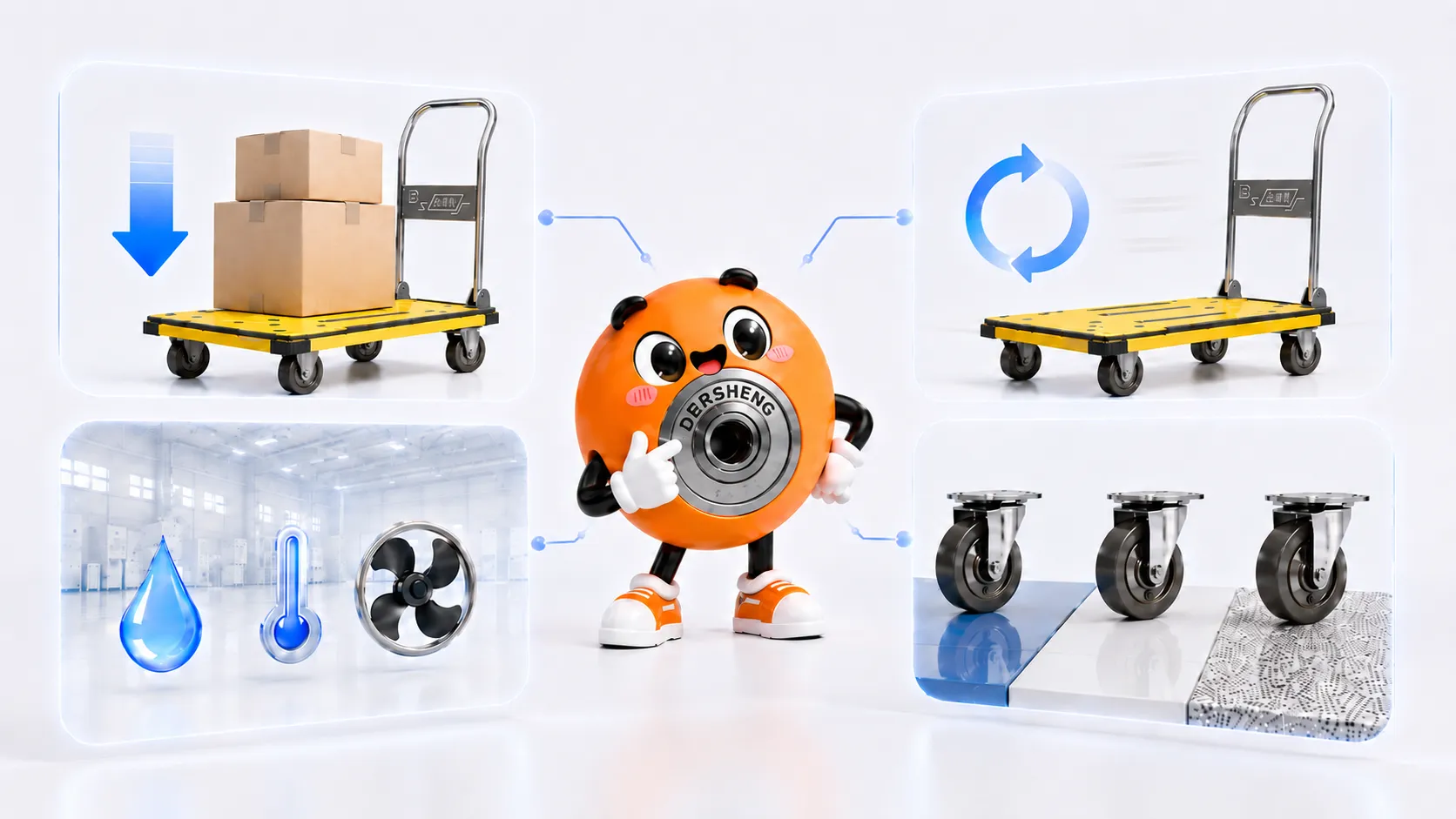
When choosing casters, you can't look at a single material's properties alone — you also need to consider equipment weight, handling frequency, travel distance, floor conditions, and operating environment together to get the most out of your wheel set.
We recommend following these 3 steps to choose the right caster wheel material and specifications.
Step 1. Confirm Safe Load Capacity to Avoid Overloading
Estimate safe load capacity and a safety margin based on the equipment's own weight, maximum load, number of casters, and actual dynamic operating conditions, to reduce the risk of overloading a single wheel due to uneven floors, shifted center of gravity, acceleration/deceleration, or sudden impact. A common estimation method is:
For 4-wheel equipment, it's generally recommended to estimate based on "3-wheel load-bearing." Under normal conditions, reserve a safety factor of 1.2–1.5×; for heavy-load handling, power towing, bumpy floors, or high-frequency use, increase the safety factor further. DERSHENG Casters' safe load testing method follows the ISO 22883 standard for wear resistance, load capacity, and fatigue cycle testing, ensuring load data is consistent and comparable.
Step 2. Evaluate Floor Material to Choose the Right Wheel Hardness
Wheel hardness is closely related to floor protection, rolling resistance, noise, and shock absorption. Choose based on your actual floor environment:
- Delicate or smooth floors: For wood, tile, or epoxy resin floors, choose elastic, floor-protective "PU wheels" or "TPR wheels" to reduce the risk of floor scratching, marks, and noise.
- Rough or outdoor environments: For concrete, rough floors, or high-wear conditions, choose highly wear-resistant "rubber wheels," "nylon wheels," or other industrial-grade wheel materials based on load and environmental needs.
Step 3. Special Conditions Require Evaluating Temperature, Oil, Chemical, and Anti-Static Needs
If your work environment involves high or low temperatures, oil, chemicals, damp washdown, ESD static control, or other special conditions, you'll need to choose the corresponding wheel material and bracket structure for that environment:
- Indoor or general industrial environments: PU and TPR wheels are generally suitable for most environments.
- Baking, painting, heat treatment, or high-temperature process environments: Evaluate heat-resistant nylon, phenolic resin wheels, heat-resistant rubber, or other high-temperature-specific wheel materials.
DERSHENG Casters' Professional Caster Configuration Solutions Effectively Improve Handling Efficiency and Wheel Life!
Caster wheel material is the key factor affecting rolling resistance, load capacity, floor protection, operating noise, shock absorption, and service life. When selecting, be sure to consider equipment weight, floor material, operating environment, and handling frequency together to ensure your casters are safer, easier to push, and more durable.
DERSHENG Casters has long specialized in industrial casters, wheel material processing, and custom wheel manufacturing, with years of professional experience, and can provide a variety of caster wheel materials and specification configurations based on different industry types, floor conditions, load requirements, or operating conditions.
Nearly Half a Century of Wheel Material Processing and Caster Manufacturing Experience
Since 1977, DERSHENG has been processing raw materials such as rubber, plastic, polyurethane, and cast iron for caster manufacturing. From material selection and process control to quality inspection, every step is strictly controlled to ensure wheel sets meet actual operating requirements for elasticity, wear resistance, grip, load capacity, and operating stability.
A Wide Range of Industrial Wheel and Caster Specifications
We offer multiple series and specifications of wear-resistant, mark-resistant, heat-resistant, conductive, anti-static, oil-resistant, and chemical-resistant wheels and casters, and can provide comprehensive wheel material and configuration planning services based on customers' equipment application, floor conditions, load rating, and environmental constraints.
QPU Series
Best for: Heavy industrial handling, damp or high-frequency use environments.
Product Features: Steel-core/cast-iron-core structure with high load capacity; QPU material offers good wear resistance and low rolling resistance, with excellent hydrolysis resistance, operating temperature range -30°C to +70°C.
Suitable for: Heavy industrial handling equipment, damp or high-frequency industrial handling equipment.
Resolute All-Purpose Wheel Series
Best for: Indoor handling, medical and commercial space equipment.
Product Features: Thermoplastic rubber elastomer (TPR), tread hardness 68±5 Shore A, offering smooth rolling, quiet operation, and excellent floor protection, operating temperature range -20°C to +60°C.
Suitable for: Indoor handling equipment, medical equipment, commercial space carts, and display equipment.
DERSHENG Casters is built around durability, long service life, and stable quality, helping businesses reduce maintenance costs and downtime risk caused by caster wear, poor rolling, wheel damage, and frequent equipment replacement — reducing the frequency of consumable replacement and waste while improving your equipment's overall operating efficiency.
Need Help Evaluating Caster Wheel Material Specifications?
Contact DERSHENG Casters today. Our professional engineering team will design the most suitable, easy-to-push, and durable caster wheel material and configuration plan based on your equipment weight, floor conditions, operating method, and environment!
Contact DERSHENG CastersAre PU or Rubber Wheels Suitable for High-Temperature Environments? Common Caster Wheel Material Questions
Q1: PU, TPR, and rubber wheels are all quiet and floor-protective — what's the real difference between them?
Compared with metal or nylon wheels, PU, TPR, and rubber wheels do offer better noise reduction and floor protection, but the three still differ in load capacity, wear resistance, elasticity, and suitable environments:
| Wheel Material | Reference Hardness | Reference Temp. Range | Advantages | Considerations | Suitable Environment |
|---|---|---|---|---|---|
| Polyurethane (PU) | approx. 85–95 Shore A | approx. -20°C to 80°C | Wear-resistant, good load capacity, low rolling resistance, good floor protection | Evaluate degradation risk under high heat, strong acid/alkali, some solvents, or long-term damp conditions | Factories, warehousing, logistics carts, equipment casters |
| Thermoplastic Rubber (TPR) | approx. 60–75 Shore A | approx. -10°C to 60°C | Low noise, mark-free, highly elastic, smooth rolling | Load capacity and wear resistance generally lower than high-spec PU wheels | Offices, medical settings, commercial spaces, retail stores, indoor carts |
| Rubber | approx. 60–80 Shore A | approx. -20°C to 65°C | Shock-absorbing, slip-resistant, good grip, comfortable over uneven floors | Less resistant to oil, solvents, high heat; risk of aging with long-term use | Uneven floors, short-distance outdoor use, environments needing shock/slip resistance |
*The hardness and temperature ranges above are common industry reference values. Please refer to DERSHENG's test reports for official specifications.
Selection tip: "Quiet and floor-protective" is only a starting point — you'll still need to evaluate wheel hardness, diameter, width, load, floor material, and usage frequency. For long-duration industrial use, "PU wheels" are a good fit; for quiet commercial environments like medical or office settings, "TPR wheels" work well; for uneven floors or where shock absorption is needed, "rubber wheels" are a good choice.
Q2: Can regular PU or rubber wheels be used in bakeries or high-temperature environments?
Regular PU or rubber wheels are not recommended for high-temperature environments. For bakeries, areas near ovens, hot-air environments, or high-temperature processes, choose caster materials with heat-resistant properties, such as heat-resistant nylon, phenolic resin wheels, heat-resistant rubber, special heat-resistant PU, or other high-temperature-specific materials.
Regular PU and rubber wheels are generally suited to room-temperature environments. If exposed for long periods to ovens, steam, hot water, high heat, or hot air, the wheel material may soften, harden, crack, deform, delaminate, develop odors, or have a shortened service life.
For high-temperature or special environments, consider the following selection tips:
- ● Near ovens or high-heat zones: Choose a heat-resistant wheel material.
- ● Moisture, steam, or washdown requirements: The bracket should be rust-proofed or made of stainless steel.
- ● Food environments or hygiene considerations: Evaluate whether the wheel material is easy to clean and meets hygiene maintenance requirements.
- ● Oily floors: Evaluate the wheel material's slip resistance and oil resistance.
- ● Need to reduce rolling noise: Balance heat resistance against quiet-operation requirements.
Selection tip: Don't look only at a caster's "maximum temperature rating" — also confirm whether that rating is for "short-term" or "long-term" heat exposure. For bakeries, central kitchens, or food processing plants, also evaluate the wheel material, bracket, bearings, lubricant, rust-proofing, and cleaning requirements together.
Q3: Is a harder wheel always more durable? Is a softer wheel always easier to push?
The relationship between wheel material hardness and durability or ease of pushing is not strictly linear. Hardness does affect wear resistance, operating noise, shock absorption, grip, floor protection, and rolling resistance, but that doesn't mean harder or softer is automatically better.
- Harder wheel materials: Generally deform less, have lower rolling resistance, and better load capacity, but are noisier, absorb shock less well, and may scratch or wear delicate floors.
- Softer wheel materials: Generally quieter, absorb shock, and grip well, but if too soft, may compress and deform under heavy loads, increasing rolling resistance and accelerating tread wear.
| Wheel Hardness | Advantages | Disadvantages | Suitable Environment |
|---|---|---|---|
| Harder wheel material | Wear-resistant, low rolling resistance, high load capacity | Noisier, poor shock absorption, may scratch floors | Smooth concrete floors, heavy industrial environments |
| Softer wheel material | Quiet, shock-absorbing, slip-resistant, floor-protective | Higher rolling resistance, wears faster, lower load capacity | Indoor floors, uneven floors, low-noise environments |
| Medium-hardness wheel material | Wear-resistant, smooth rolling, floor-protective | Needs matching to environment | General warehousing, logistics carts, equipment casters |
Selection tip: Whether a wheel is durable and easy to push depends on more than hardness alone — wheel diameter, width, resilience, bearing configuration, load conditions, floor conditions, and travel distance all matter. The right caster wheel material should balance durability, rolling efficiency, floor protection, noise control, and shock absorption.
Q4: Can caster wheel material be replaced later? Can old equipment simply have its wheel material swapped?
Most caster wheel treads can be replaced independently, but before replacing, we recommend confirming the following points to avoid replacing only the wheel's appearance while overlooking actual load and compatibility requirements:
- ● Bracket type and axle specifications: Confirm the existing caster's mounting hole positions, axle diameter, and wheel width are compatible with the new wheel material.
- ● Consistent wheel diameter: If the new wheel's diameter differs significantly from the original, it may affect equipment height and rolling smoothness.
- ● Re-evaluate load capacity: Different materials have different load capacities, so re-confirm whether the per-wheel load is sufficient based on total equipment weight and safety factor.
- ● Floor and environmental conditions: Before replacing the material, reconfirm whether the floor material, temperature, oil, and chemical exposure in the operating environment suit the new wheel material.
DERSHENG Casters' professional advice: Before replacing, provide the original caster model, total equipment weight, and actual operating environment so the manufacturer can help confirm the new wheel material's compatibility and load rating — avoiding discovering insufficient load capacity or excessive wear only after replacement.
Q5: Can casters of different materials be mixed on the same piece of equipment?
Generally, mixing wheel materials with significant differences on the same piece of equipment is not recommended, for the following main reasons:
- ● Different rolling resistance: Different materials have different rolling resistance, which can cause the equipment to drift or veer off course while moving.
- ● Different elasticity and wear rates: Softer and harder wheel materials wear at different rates, and over time this can create a height difference, worsening uneven wear on one side.
- ● Uneven load distribution: Differences in load capacity between materials can shift the equipment's center of gravity and increase the risk of overloading a single wheel.
If special conditions require mixing materials — such as one side needing braking, bearing additional lateral force, or needing a special-environment wheel material — consult a caster manufacturer in advance to evaluate load distribution and travel stability, to avoid affecting equipment safety and wheel service life.
DERSHENG Casters' professional advice: Unless there's a special operational requirement, we recommend using casters of the same material and specification on the same piece of equipment, to ensure even load distribution, stable direction of travel, and a longer overall service life for the wheel set.