Quick Summary: Roll Cage Trolley Selection Essentials
- Pick the frame style first: Choose 2-sided, 3-sided, 4-sided, or folding based on goods type, picking method, transport frequency, and return logistics.
- Then check load capacity: Size to your typical maximum load with a safety margin to avoid frame deformation or a sagging base from prolonged overloading.
- Security and space: For high-value or precision items, prioritize lockable security features; for limited storage space, prioritize folding or stackable designs.
- Match the casters: Choose wheel material for your floor type, and set the rigid-to-swivel caster ratio based on whether you need straight-line tracking or tight turning.
What Is a Roll Cage Trolley? Basic Structure and Common Styles
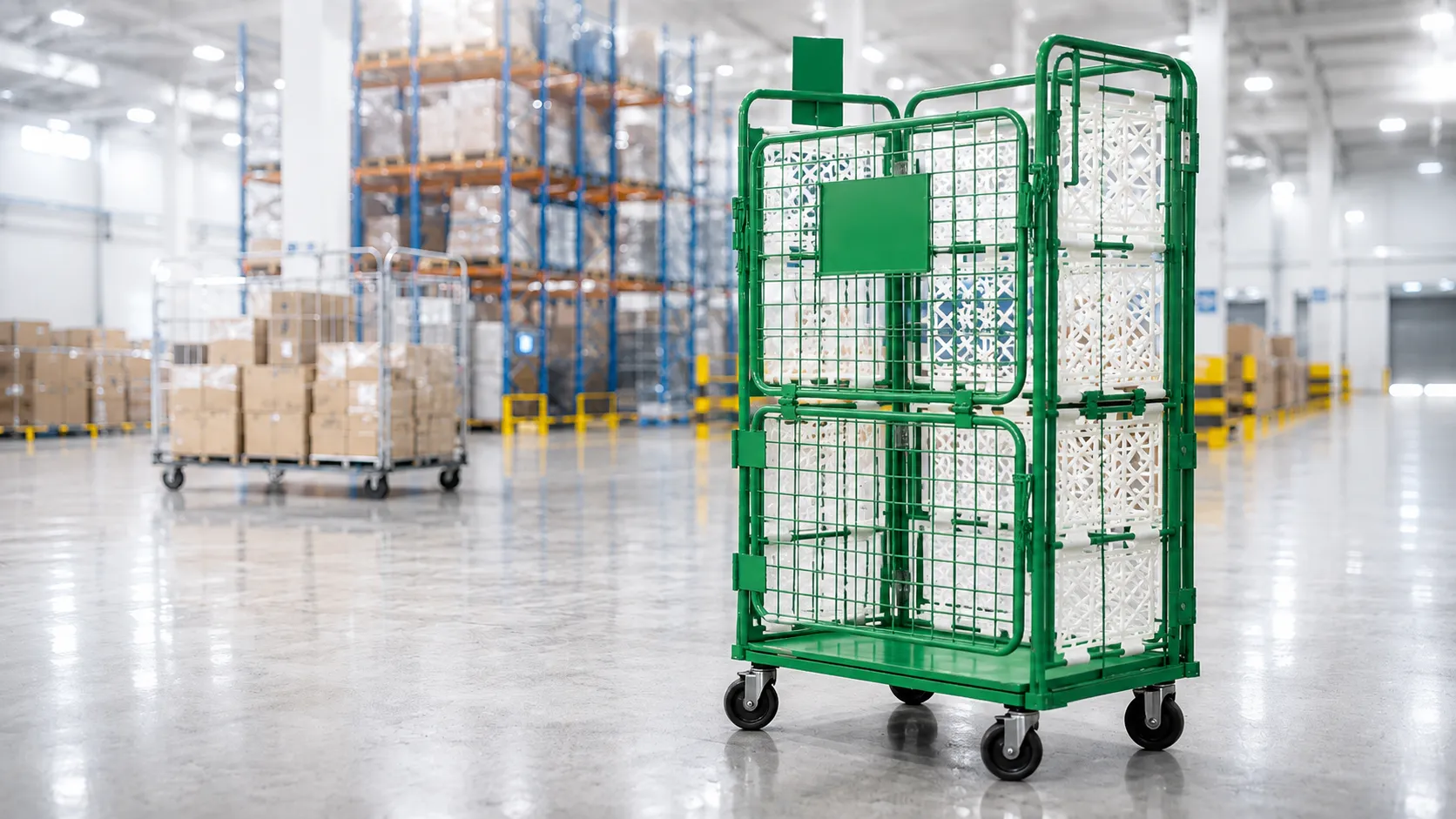
A roll cage trolley — also called a cage cart, roll cage, or logistics cart — is a mobile cart with a mesh or frame structure, commonly used for consolidating, picking, distributing, and moving goods through a warehouse. It reduces the physical strain of manual handling and lowers the risk of items tipping, sliding, or spilling when moving large volumes of goods.
A roll cage trolley is mainly made up of a metal frame, mesh side panels, a load-bearing base, and casters. The casters at the base are the key factor in how smoothly the cart pushes, how well it steers, and how stable it remains over long-term use.
Common roll cage trolley styles include 2-sided, 3-sided, 4-sided, and folding designs. Which one to choose depends mainly on the type of goods, picking method, transport frequency, warehouse space, and return logistics — different structures suit different use cases, and more sides doesn't automatically mean a better cart. The right choice always depends on your actual operating conditions.
Here are the 4 common roll cage trolley styles:
| Style | Characteristics | Common uses | Best suited for |
|---|---|---|---|
| 2-sided (open left/right doors only) | Highly open, fast to load and unload | Warehouse picking, short-distance handling, production line turnover, store replenishment | Goods that won't easily fall out, environments needing frequent loading/unloading |
| 3-sided (left/right and rear doors, no front door) | Good containment, easy to load | Distribution centers, retail replenishment, e-commerce warehousing, general delivery | The most common roll cage trolley format, suitable for most standard goods |
| 4-sided | Best containment, lowest risk of items falling out | Long-distance delivery, transfers, high-value or fragile goods | Environments needing high transport stability where goods could easily slide out |
| Folding cage cart | Collapsible or nestable when empty, saves return and storage space | Chain retail networks, store delivery, reverse logistics, multi-stop delivery | Businesses with frequent empty-cart returns and limited warehouse space |
How to Choose a Roll Cage Trolley: 5 Key Factors Before You Buy

When choosing a roll cage trolley, evaluate your actual goods, site constraints, and usage frequency carefully — an ill-fitting size, insufficient load capacity, poor storage efficiency, or unsuitable material will all hurt your operating efficiency down the line.
Factor 1: Cart Dimensions
Confirm that the cage cart's length, width, and height will fit through your warehouse aisles, elevators, doorways, and freight lifts, and that staff have enough clearance to load, unload, and push it comfortably.
Factor 2: Load Capacity
Assess the weight and volume of what you handle day-to-day, and confirm the frame can bear the actual load without deforming, sagging at the base, or becoming unstable to push under prolonged overload. If your load varies, size the cart to your higher typical maximum with a safety margin — don't run it near its rated limit as a matter of routine.
A common way to estimate load for a 4-wheel cage cart is to assume 3-wheel support and apply a safety factor:
On flat, even floors, a safety factor of 1.2–1.5 is typically reasonable. For uneven floors, frequent turning, high-frequency use, or powered towing, increase the safety factor further to reduce the risk of premature caster wear and frame deformation from overloaded wheels.
Factor 3: Security Features
If you frequently move high-value goods, precision parts, controlled materials, or items that must not be mixed up, prioritize a fully enclosed mesh, lockable doors, latching hardware, or a dedicated security cage cart to reduce the risk of items falling out or going missing.
Factor 4: Space Flexibility
If your workspace is tight, prioritize a cage cart with folding, stacking, L-shaped, or butterfly-style storage features to improve empty-cart return efficiency and warehouse space utilization.
Factor 5: Surface Corrosion Protection
Cage cart frames are typically metal, so if the cart will spend extended time in humid environments, food plants, cold storage, or rain-exposed loading docks, prioritize a galvanized, coated, or corrosion-resistant frame to reduce rust and structural degradation over time.
If the site requires frequent washdowns or exposure to cleaning agents, also confirm that the surface treatment, welds, hardware, and caster brackets are all suitable for wet or corrosive conditions.
How to Configure Roll Cage Trolley Casters: Material and Wheel-Group Layout Are What Make It Easy to Push
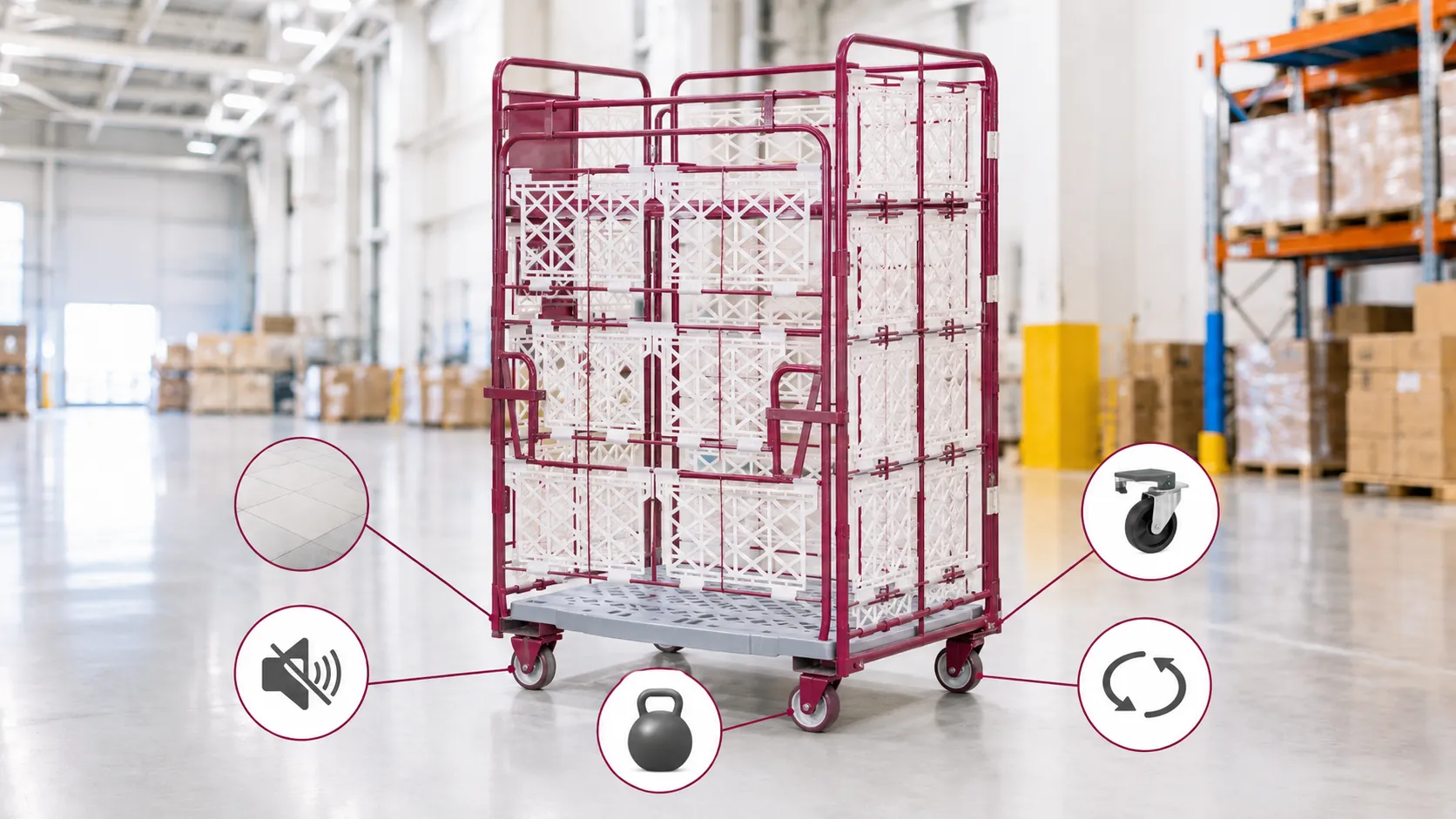
How smoothly a roll cage trolley pushes depends heavily on its casters. When selecting casters, match the wheel bracket and wheel-group configuration to your floor material, noise requirements, load, and steering needs.
Choosing Caster Material by Floor Type
- Tile, epoxy resin, and smooth indoor floors: Prioritize TPR, premium elastomer wheels, or polyurethane (PU) wheels for low noise, floor protection, and shock absorption, reducing the risk of scratched floors or wheel marks.
- Concrete, warehouse platforms, and general industrial floors: Based on actual load and wear requirements, choose polyurethane (PU) wheels, nylon wheels, or other industrial wheel materials for stable, durable rolling.
- Carpet, commercial spaces, and low-resistance environments: PP wheels, nylon wheels, or other low-resistance wheel materials let the cart move smoothly over soft carpet or commercial flooring.
- Cold storage, wet loading docks, and food storage: Choose wheel materials specifically rated for cold resistance, corrosion resistance, slip resistance, hydrolysis resistance, cleaning-agent resistance, or hygiene compliance to prevent tread hardening, seized bearings, or bracket corrosion.
Configuring the Wheel Group by Straight-Line and Steering Needs
Wheel-group configuration directly affects a cage cart's straight-line stability and steering agility. The most common setup pairs rigid (fixed) casters with swivel casters, keeping the cart tracking straight over long distances while still steering well in tight aisles or corners.
| Wheel-group configuration | Characteristics | Best suited for |
|---|---|---|
| 2 rigid casters + 2 swivel casters | Good straight-line stability, easy to steer | Long-distance straight-line handling, loading docks, warehouse aisles |
| 4 swivel casters | Very maneuverable in place, but tends to drift when moving straight | Tight spaces requiring frequent turns or on-the-spot direction changes |
| 2 swivel casters + 2 swivel brake casters | Balances mobility with secure positioning | Parking, loading/unloading, ramps, areas requiring anti-slip positioning |
| Central rigid caster configuration | Improves steering feel and handling under heavy load | Heavy-duty carts, long-frame carts, high-frequency handling |
Case Study: Retail Chain Delivery Cage Cart Steering Poorly on a Wet Loading Dock
Operating conditions: A retail chain's delivery cage carts moved frequently between an outdoor loading dock and an indoor sales floor in wet weather, with a route that included slippery ramps, expansion joints, and frequent tight turns over short distances — and the load weight varied significantly trip to trip.
Observed issue: The cage cart noticeably pulled to one side on the ramp and at turns, and pushing resistance increased on wet days. An on-site inspection compared wheel-to-ground contact, tread wear, bearing rotation, and load placement, and found the issue was linked to an insufficient rigid-to-swivel caster ratio for the ramp turns, along with inadequate wet-surface grip on the wheel tread.
Resolution: The wheel-group ratio was re-evaluated, and the original wheels were replaced with hydrolysis-resistant polyurethane (PU) wheels with better grip; a swivel brake caster was added for the ramp section to hold position during loading and unloading. After the change, the cage cart's steering stability and push smoothness on the wet ramp both improved noticeably.
*This case has been de-identified. Operating conditions, inspection points, and the resolution are shared for evaluation purposes; customer name, store location, and project details are not disclosed.
This article was prepared by a technical team with experience in industrial casters, roll cage trolley frame design, wheel material processing, and on-site selection, based on real-world cage cart operating conditions, dynamic load data, wheel-group configuration, and customer feedback.
Choose DERSHENG Casters for a Roll Cage Trolley Solution Built Around Your Operation
Matching cage cart style and casters to your goods weight, cart dimensions, storage needs, and operating environment doesn't just improve handling efficiency and space utilization — it also significantly reduces safety risk and long-term maintenance cost.
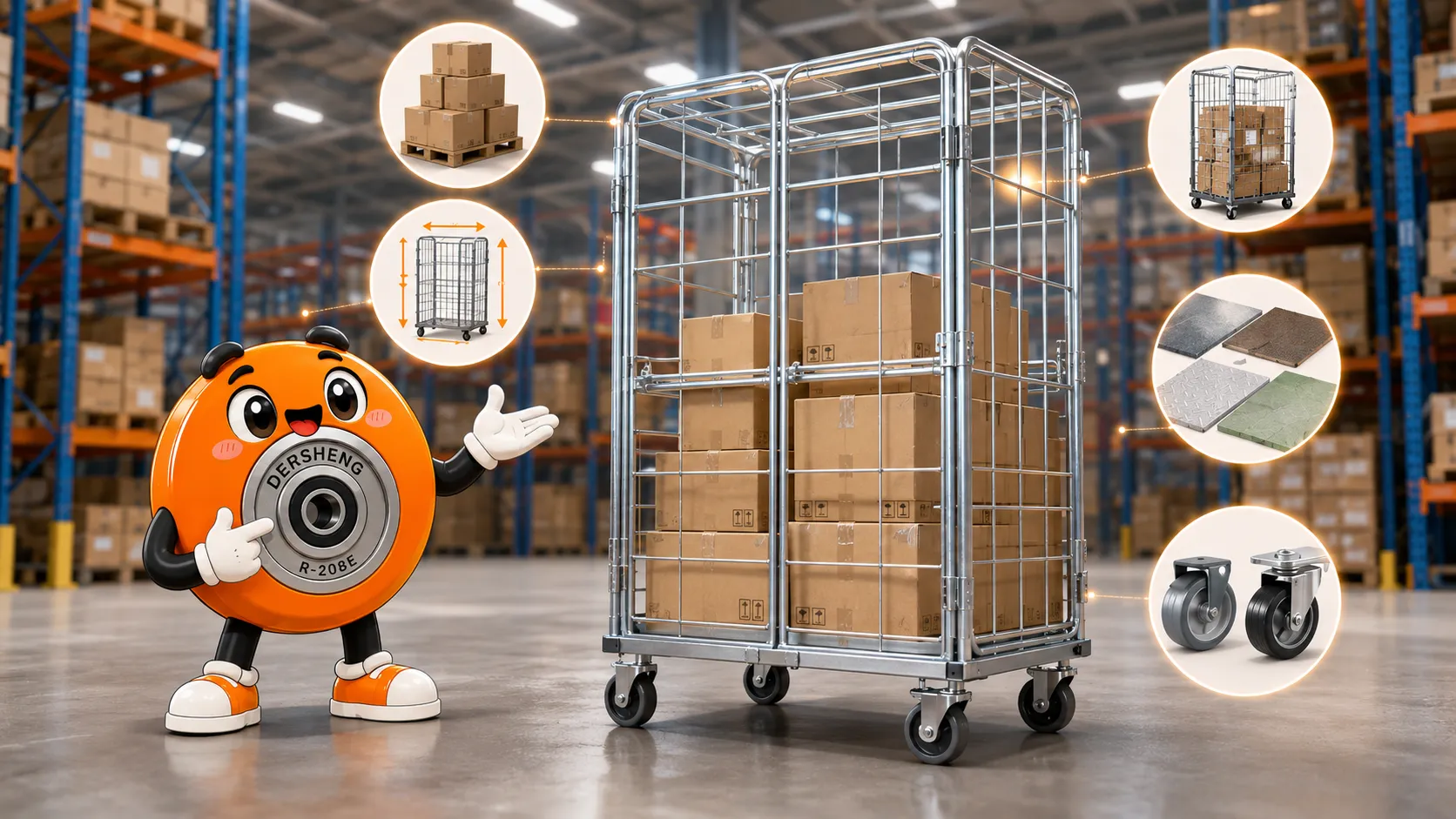
DERSHENG Casters has extensive experience manufacturing logistics carts, industrial casters, and wheel assemblies, and can design a dedicated roll cage trolley and caster configuration for warehousing, distribution, industrial, and commercial applications:
Decades of logistics cart and material-handling equipment manufacturing experience
DERSHENG doesn't just supply casters — we have deep experience manufacturing logistics carts, cage carts, and material-handling equipment. We build frames that balance load capacity, maneuverability, and durability for high-frequency warehousing and industrial handling environments.
Standard, lockable, and custom-spec roll cage trolleys
We offer standard U-frame cage carts, custom-spec carts, general logistics carts, and lockable security cage carts to fit different industries. Our security cage carts feature a robust mesh, lockable doors, and latching hardware, ideal for high-value goods, precision parts, or controlled inventory.
Purpose-configured casters for your operating environment
Whether it's cold storage, a rain-exposed loading dock, an electronics plant, a warehouse floor, or a commercial space, DERSHENG can precisely configure caster material and structure to match your roll cage trolley's operating environment — including wear-resistant, low-noise, anti-static, corrosion-resistant, cold-resistant, or hydrolysis-resistant options as needed.
Need help specifying a roll cage trolley?
Contact DERSHENG Casters — our engineering consultants will design a durable, easy-to-push roll cage trolley solution based on your facility's aisles, floor surfaces, and load requirements.
Contact DERSHENG CastersCaster Tips for Wet Environments: Roll Cage Trolley FAQ
Q1: Should I choose a 2-sided, 3-sided, 4-sided, or folding roll cage trolley?
Common roll cage trolley styles include 2-sided, 3-sided, 4-sided, and folding designs. The right choice depends mainly on the type of goods, picking method, transport frequency, warehouse space, and return logistics — it should be based on actual operating needs, not simply on how many sides the cart has.
As a general guideline:
- Internal warehouse picking, short-distance handling: 2-sided or 3-sided cage carts are usually more convenient because retrieval is faster.
- Distribution, transfers, or higher stacking of goods: 3-sided or 4-sided cage carts are safer, reducing the risk of goods falling out.
- Chain retail, e-commerce logistics, store delivery, or frequent empty-cart returns: Folding cage carts usually have the advantage, reducing the space and return-shipping cost of empty carts.
In short: prioritize a 2-sided or 3-sided cart for retrieval speed, a 3-sided or 4-sided cart for product protection, and a folding cart for space and return efficiency.
Selection tip: When choosing a roll cage trolley, also confirm the cart dimensions, mesh spacing, shelf design, surface treatment, load requirements, and caster configuration together — all of these affect the cart's service life and how safely it can be pushed.
Q2: My cage cart is hard to push or keeps pulling to one side — is that a frame problem or a caster problem?
A roll cage trolley that's hard to push, steers poorly, or keeps pulling to one side can be related to frame structure, caster configuration, wheel wear, bearing condition, frame deformation, or floor conditions. Here are the 3 most common causes:
Cause 1 — Unsuitable caster configuration: If a cart needs to run straight over long distances but is fitted with 4 swivel casters, it can drift unpredictably. If the environment requires frequent turning but has too many rigid casters, the cart can become hard to steer and push.
Cause 2 — Wheel wear or debris: Over time, tread can wear unevenly, deform, crack, or delaminate, and bearings can seize or get tangled with tape or lint — all of which increase rolling resistance and cause the cart to pull to one side. Check whether all four wheels make even contact with the ground, whether tread wear is uneven, whether swivel wheels rotate freely, whether bearings are seized or rusted, whether anything is wrapped around a wheel, and whether the brake is fully released.
Cause 3 — Frame deformation or shifted center of gravity: If the cart has been struck, overloaded, or used to store heavy items long-term, the frame can warp, causing uneven load distribution across the four wheels. Goods consistently loaded off-center can also cause the cart to drift toward the heavier side when pushed.
Quick diagnosis: If the cart is hard to push even when empty, check the casters, bearings, wheel mounts, and frame first. If it pushes fine empty but pulls to one side once loaded, check load distribution and center of gravity. If it's only difficult on certain floor sections, the cause may be related to floor material, level changes, or wheel tread material.
In short, a hard-to-push cage cart rarely has a single cause — evaluate frame structure, caster configuration, wheel condition, load distribution, and floor conditions together for an accurate diagnosis.
Q3: What should I look for in cage cart casters used in cold storage?
In freezers or low-temperature storage, wheel tread material can harden, become brittle, or lose elasticity at low temperatures, increasing rolling resistance, cracking the tread, or reducing grip.
We recommend cold-resistant polyurethane (PU), special rubber, stainless steel brackets, or corrosion-resistant casters, and confirming material suitability against your actual temperature range.
Key points: choose tread material rated for cold temperatures, check whether the tread hardens in the cold, ensure bearings and lubricant are cold-rated, avoid standard rubber or wheel materials not suited to low temperatures, and pay attention to slip resistance and braking if the floor may have ice or moisture.
Q4: What should I look for in cage cart casters used on wet loading docks?
Loading docks are frequently exposed to moisture, rain, dust, ramps, and floor level changes. If a caster's corrosion resistance is inadequate, the bracket can rust, bearings can seize, brakes can fail, or wheels can stop turning smoothly.
For frequent use, choose hydrolysis-resistant polyurethane (PU) wheels, stainless steel casters, sealed bearings, or corrosion-resistant brackets to reduce maintenance frequency and rolling resistance.
Key points: choose galvanized, stainless steel, or corrosion-treated brackets; bearings should have good water and dust resistance; wheel tread material should balance wear resistance and slip resistance; add a brake caster if the route includes ramps or loading/unloading; and avoid undersized wheel diameters where floors are uneven or have drain covers.
Q5: What should I look for in cage cart casters used in food storage?
In food storage or food processing environments, you need to consider cleanliness, hygiene, corrosion resistance, and exposure to chemical cleaning agents, in addition to how easily the cart pushes. Unsuitable caster materials can degrade faster from washing, disinfection, moisture, or cold.
Stainless steel casters paired with hydrolysis-resistant polyurethane (PU) wheels, nylon wheels, or other food-safe wheel materials are generally recommended. If the site requires frequent washdowns or acidic/alkaline cleaning agents, also confirm the chemical resistance of the tread, bracket, bearings, and lubricant.
Key points: prioritize stainless steel brackets or corrosion-resistant materials; wheel tread should resist water, cleaning agents, and some chemicals; avoid materials that absorb water, crack, or shed particles easily; bearings should be water-resistant, dust-resistant, or sealed; and confirm materials meet your site's food-safety requirements.