What is Swivel Caster? Quick summary of key selection points
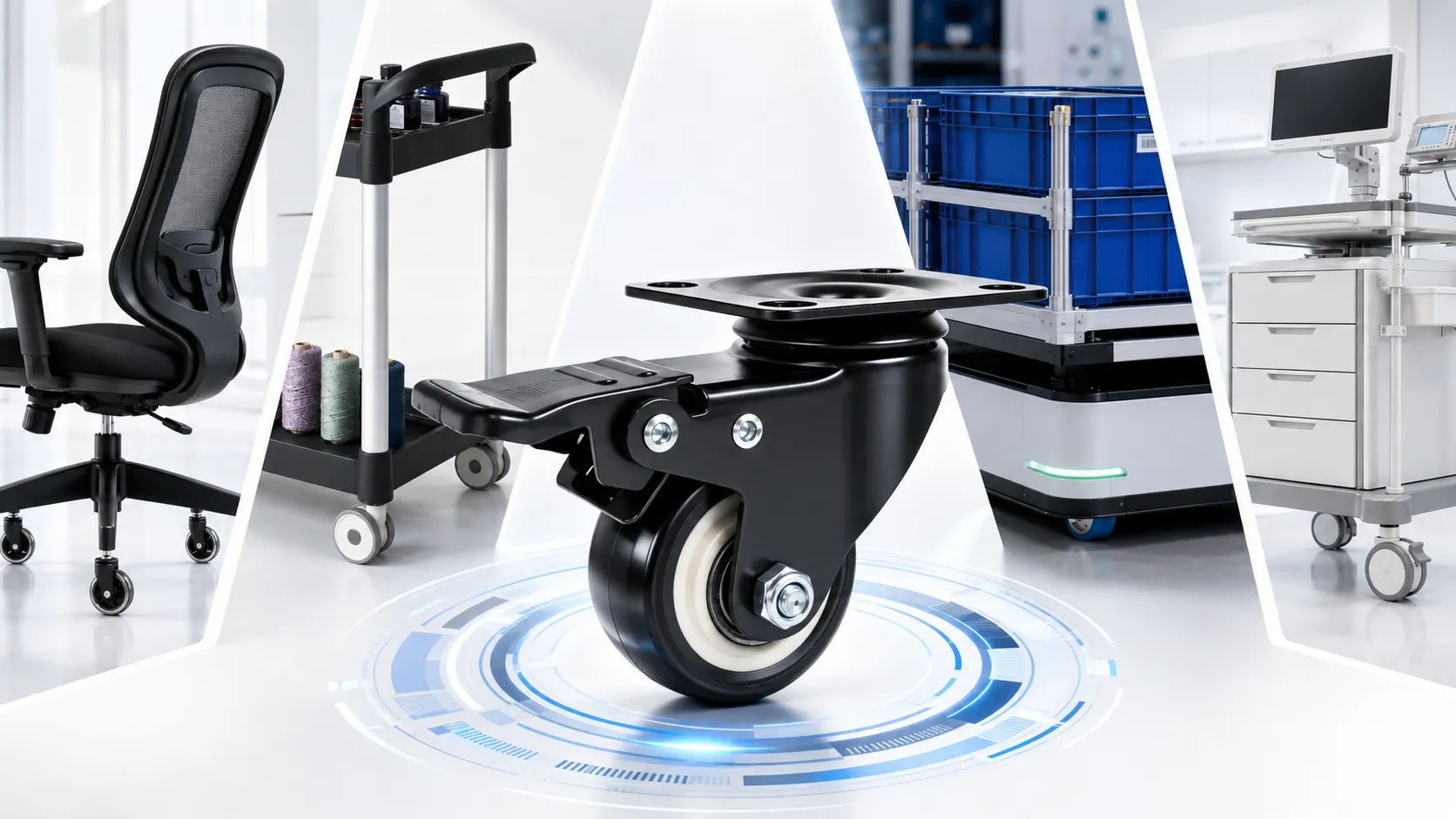
The Swivel Caster, also known as the "Universal Caster" or "Mobile Caster", is a caster component that can freely rotate 360 degrees on the horizontal plane. It is mainly composed of three major structures: the wheel unit, the swivel bearing and the metal bracket. Compared with the fixed Caster, the Swivel Caster has the advantages of a smaller turning radius and lower push-pull steering resistance, so even in narrow passages, corners or complex routes, the cart can be moved. Machines or handling equipment can move and turn flexibly.
The core of swivel caster selection is not just to look at "whether it can rotate", but to simultaneously evaluate the usage scenario, ground conditions, load requirements and rotating structure level. Daily products value silence and lightness, industrial products value labor-saving and control, and Automation Equipment values durability and stability. The selection logics of the three are different.
- ● Let’s look at the scene first: The Swivel Caster for industrial use focuses on reducing starting and steering resistance; the Swivel Caster for Automation Equipment focuses on structural durability and low rolling resistance; the Swivel Caster for daily/commercial use focuses on silence and lightness.
- ● Let’s look at the structure again: The wheel alone affects silence, wear resistance and load-bearing; the swivel bearing affects rolling and steering smoothness; the metal bracket affects the overall load-bearing capacity and rotational stability.
- ● Confirm environment: For indoor floors such as wooden floors and tiles, TPR or highly elastic Nylon can be prioritized; for humid and chemical environments, it is recommended to choose stainless steel brackets with acid and alkali resistant Wheel materials.
- ● With brake: Depending on the equipment weight, operation method and positioning accuracy requirements, choose wheel brake, direction brake, double brake or additional fixed tripod.
This article is compiled by a technical team with experience in swivel casters, movable casters, swivel bearings and customized wheel sets. The content is based on actual wheel material processing, rotating structure design, on-site selection experience and common troubleshooting cases.
Basic principles and core structure analysis of 360-degree rotation
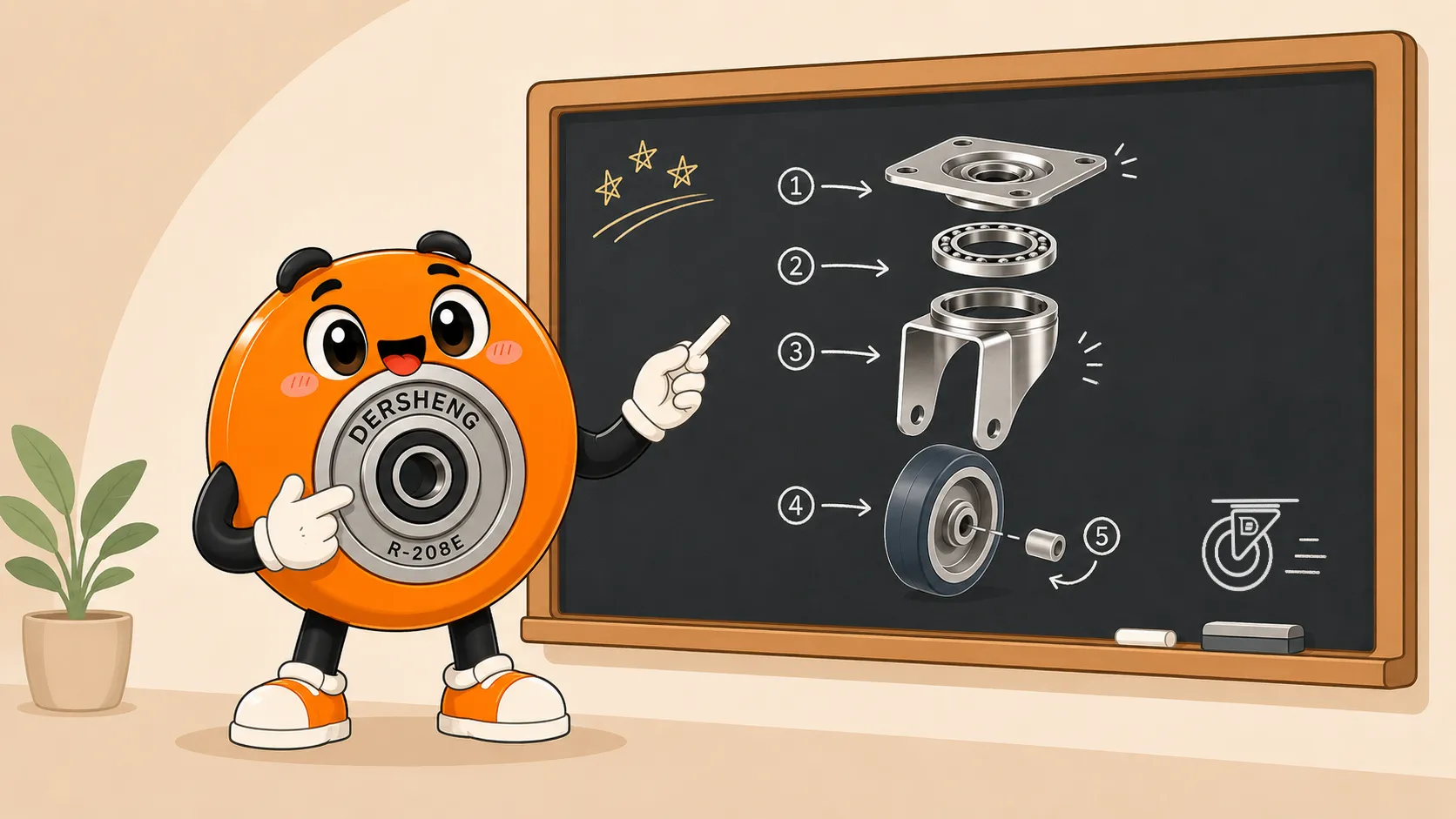
The Swivel Caster, also known as the "Universal Caster" or "Mobile Caster", is a Caster component that can freely rotate 360 degrees on the horizontal plane. It is mainly composed of the following three major structures:
- ● Wheel unit: The material and hardness of rolling parts that are in direct contact with the ground will directly affect the quietness, wear resistance, shock absorption, ground protection and load-bearing performance.
- ● Rotary bearing: It is the key to the smooth rolling and steering of the wheel. High-quality bearings can significantly reduce frictional resistance and save more effort during operation.
- ● Metal bracket: Connecting the wheel body and the bottom of the equipment, it is usually made of steel or stainless steel. Its bracket structure, steel ball turntable and thickness design will affect the overall load-bearing capacity and rotation stability.
Compared with the fixed Caster, the Swivel Caster has the advantages of smaller turning radius and lower push-pull steering resistance. Therefore, it can allow carts, machines or handling equipment to move and turn flexibly even in narrow aisles, corners or complex routes.
What are the common universal casters? Comparison of the differences of swivel caster in 3 major application scenarios
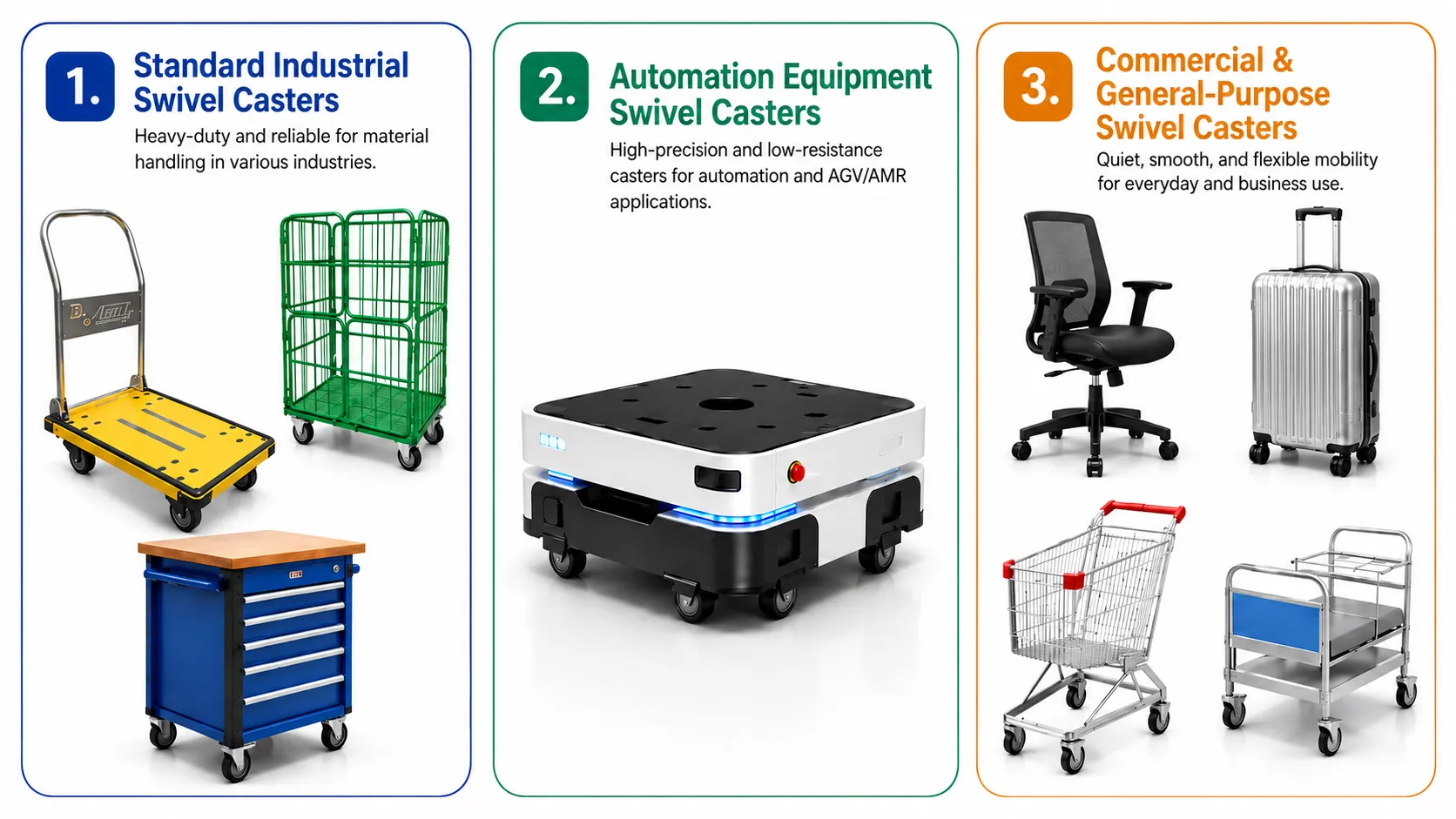
The performance and uses of the Swivel Caster will be somewhat different in different usage scenarios. For example, Industrial use places more emphasis on labor saving and control; Automation Equipment places more emphasis on durability and stability; Daily use places more emphasis on silence and lightness. The following is a detailed description of the three major application scenarios:
1. Traditional industrial swivel caster
The design focus of the swivel caster for industrial use is to reduce starting resistance and steering resistance, so that operators can save more effort when pushing, turning and positioning. It is commonly used in "intermittent movement" factory carts, logistics cages, tool tables, mechanical platforms and tool equipment.
Usually, it can be equipped with "flat type" or "screw type" design according to Equipment installation requirements, and can be equipped with single brake, double brake or direction lock and other braking structures to improve the safety of positioning.
2. AutomationEquipment uses swivel caster
Automation Equipment requires long-term, high-frequency, long-distance operation, so it pays more attention to structural durability, low rolling resistance, full-time grounding and shock absorption capabilities, and is mostly used in unmanned guided vehicles (AGV), autonomous mobile robots (AMR), and the driven wheel or driven balancing wheel of smart warehousing equipment.
It is usually paired with high-rebound PU Wheel material, spring shock-absorbing structure or balanced Wheel system to ensure that the equipment is running smoothlyexpansion joint, it can still maintain high stability when entering the elevator entrance or on uneven ground, and reduce slippage, vibration and positioning errors.
3. Swivel Caster for civilian use/commercial use
Including "daily necessities" such as office chairs, suitcases, supermarket shopping carts, display stands, medical beds, indoor carts, etc., we pay more attention to the performance of quietness and light operation, and special attention is paid to preventing the wheel from scratching the floor in the design.
The material is mostly made of TPR, artificial rubber or plastic steel double ball Wheel, suitable for use on indoor floors such as wooden floors, ceramic tiles, polished quartz tiles, etc., and can be equipped with anti-tangle or maintenance-free designs according to needs.
Comparison table of 3 major application scenarios
| Application scenarios | Design focus | Common Wheel materials | Represents Equipment |
|---|---|---|---|
| Traditional Industrial use | Reduce starting and steering resistance, save effort and ensure safe positioning | PU Wheel, Rubber Wheel | Factory carts, Logistics cage carts, tool tables |
| For AutomationEquipment | Durable structure, low rolling resistance, full-time grounding, shock absorption | High rebound PU Wheel | AGV, AMR, smart warehousing Equipment |
| People's livelihood/commercial use | Silent, lightweight, avoid scratching the floor | TPR, artificial rubber, plastic steel double ball Wheel | Office Chair, Luggage, Shopping Cart, Medical Bed |
How to choose Wanxiang Wheel? Judgment based on usage environment and industry needs
When selecting a swivel caster, you should choose the appropriate wheel material and bracket structure according to the usage environment. The following are suggestions for selecting swivel casters for the four common usage environments:
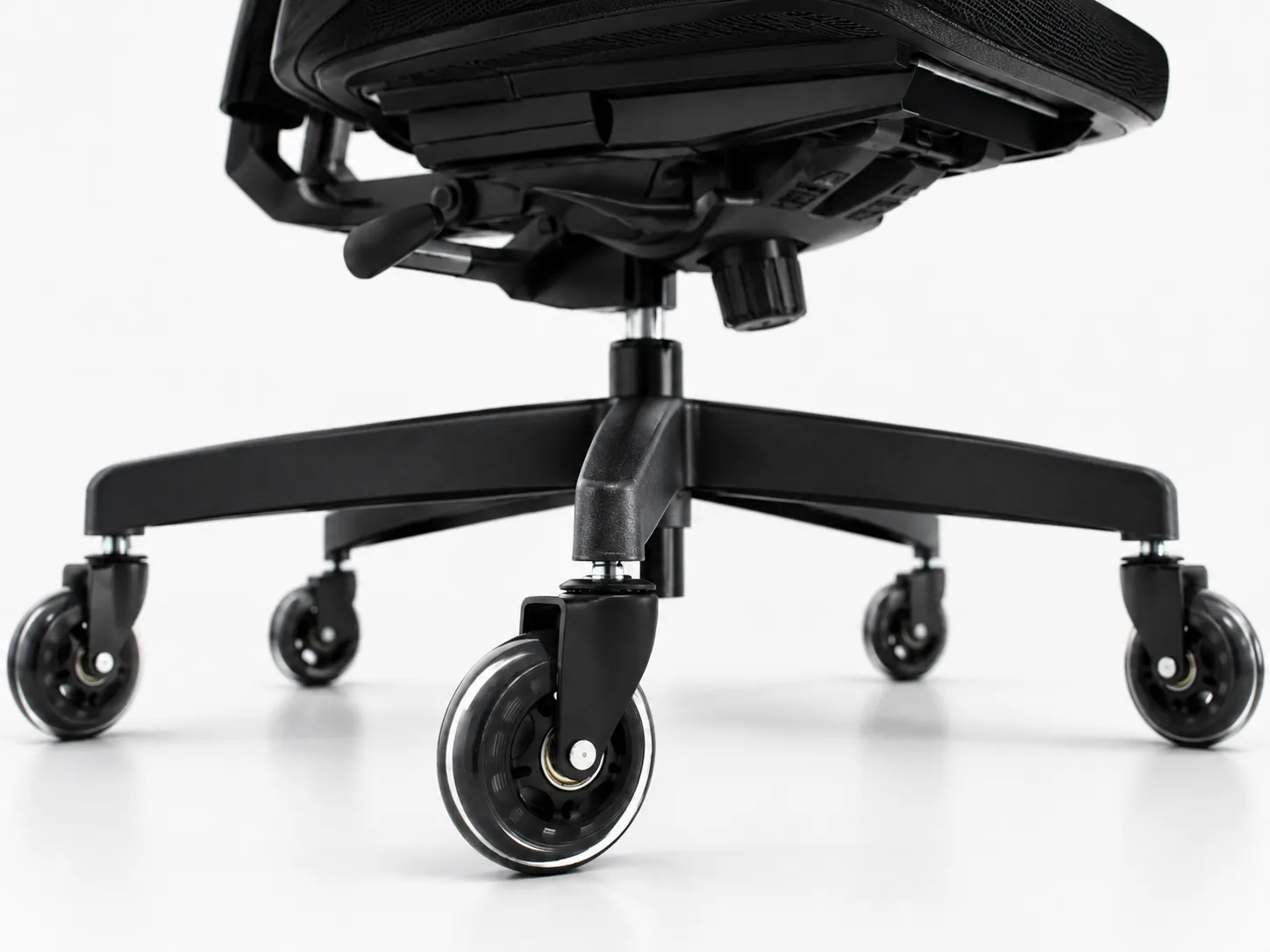
Different usage environments have very different requirements for swivel casters: offices and commercial offices value silence and floor protection, medical clean rooms value hygiene and precision bearings, food chemical lines value corrosion resistance, and automation warehousing values wear resistance and low resistance.
Office, business trip
For example, office chairs, suitcases, display racks, etc. are mostly used in wooden floors, tiles, carpets or indoor smooth floors. It is recommended to give priority to "TPR", "high elastic Nylon" or other wheel materials that are not easy to leave wheel marks and promote lower sound to reduce floor wear and noise interference.
Medical facilities, laboratories, clean rooms
For example, medical beds, medical carts, laboratory instruments, clean room equipment, etc., the use environment has stricter requirements for "noise" and "hygiene". It is recommended to choose "central control double ball Wheel" with precision bearings, "anti-rust bracket", or "PU Wheel material" that is resistant to cleaning and does not leave marks easily.
Food Processing, Chemical Cleaning Line
Such as Food Processing Equipment, cleaning lines, humid environments and work areas that may be exposed to chemical detergents. In order to avoid wheel set failure caused by moisture, rust or corrosion, it is recommended to give priority to "stainless steel brackets" and hard wheel materials with low water absorption, acid and alkali resistance, and corrosion resistance, such as "Nylon", "PP", etc.
AutomationEquipment, smart warehousing
Such as AGV, AMR, material turnover system and smart Logistics Equipment, etc. This type of Equipment needs to operate for a long time. It is recommended to give priority to a swivel caster with high wear resistance, low resistance and high earthquake resistance, such as a "high rebound PU Wheel" or a wheel group with a shock-absorbing balance structure to reduce the starting energy consumption of the motor, reduce the vibration of the fuselage, and improve the operational stability of the equipment.
Common Swivel CasterWheel Material Specification Reference Table
The following summarizes the load range, hardness, applicable ground and characteristics of five common wheel materials, providing a preliminary reference for selection. The actual specifications varies depending on the wheel diameter, bracket and bearing structure. It is recommended to confirm the product Specification table or consult a selection consultant.
| Wheel material | Common wheel diameter range | Wheel load reference | Shore hardness (Shore A) | Applicable ground | Main features |
|---|---|---|---|---|---|
| TPR/artificial glue | 50–100 mm | 30–150 kg | 75–85 A | wooden floors, tiles, polished quartz tiles |
Silent, ground-protecting, lightweight, Suitable for daily necessities in office and commercial spaces. |
| Plastic steel double ball Wheel | 50–75 mm | 30–100 kg | Hard (Shore D 65–75) |
Smooth indoor floor | Lightweight, low cost, Commonly found in luggage, display racks and other lightweight items. |
| PU(Polyurethane) | 50–150 mm | 80–400 kg | 80–95 A | epoxy floor, cement, Mildly uneven ground |
Wear-resistant, low resistance, not easy to leave marks, Widely used in Industrial and Medical carts. |
| High rebound PU | 75–150 mm | 100–500 kg | 85–95 A | Epoxy floor, expansion joints, Slightly dropped ground |
Low rolling resistance, high rebound, impact resistance, Suitable for AGV/AMR AutomationEquipment. |
| Nylon/PP | 75–150 mm | 100–600 kg | Hard (Shore D 70–85) |
Smooth cement, epoxy floor | Chemical resistance, low water absorption, Suitable for Food Processing and chemical cleaning environments. |
※ The above data is a reference for the common Specification range in the industry. The actual load and hardness vary according to each brand, wheel diameter and bracket design. Please refer to the product Specification book when selecting.
Leave it to Dershengang to create an exclusive swivel caster solution for you!
The adaptability of the swivel caster to the environment of use will greatly affect the smoothness of the equipment's implementation, steering flexibility and service life. Therefore, it is necessary to select the appropriate Wheel material, bracket and braking structure based on the equipment's weight, frequency of use, ground conditions and industrial needs to ensure that the equipment is used more effortlessly, smoothly and safely.
Get a good WheelWe have been deeply engaged in caster manufacturing and wheel body material processing for many years. Whether it is for industrial use, civilian use, commercial use, automation or medical equipment, we can tailor-made exclusive universal caster and customized wheel group solutions according to different use areas and control requirements.
- ● Multi-Specification universal caster production and testing capabilities: Deyi has passed ISO 9001 quality management verification and has complete production and testing equipment. It can stably manufacture swivel casters with different specifications and load requirements. It also provides suitable rotating structures, bracket designs and wheel materials to ensure stable steering and movement performance.
- ● The product line covers Industrial heavy-duty Wheel, Medical Wheel and commercial Wheel: The Deyi product line supports diverse market needs, ranging from traditional industrial heavy-duty casters, logistics cart wheels, to medical-specific plastic steel wheels, central control double-ball wheels and other series.
- ● Customized adjustments based on Equipment structure and walking environment: Deyi has accumulated a variety of Specifications and rich practical cases, and can accurately adjust the swivel caster configuration, including eccentricity, bracket structure, wheel material, braking mechanism, etc., according to the equipment chassis, installation hole spacing, actual load, floor conditions and operating methods.
Need help evaluating a Wanxiang WheelSpecification?
Welcome to contact Dejianshanghao Wheel and let our professional engineering consultant team customize a safer, smoother and more durable swivel caster solution for you based on your equipment weight, operation method and walking environment!
Contact us at WheelWanxiang Wheel uses Frequently Asked Questions
Is the stroller most flexible if all four wheels are equipped with swivel casters? Why do some strollers need fixed wheels?
The steering flexibility of four swivel casters is indeed the highest, but when driving in a straight line over long distances, it will be better to control it with a few fixed wheels.
The swivel caster has the characteristic of 360-degree free rotation. Although it is very convenient to turn, move laterally or adjust the direction in a small space, it is easy to drift left and right, snake or have unstable direction when walking in a straight line. Especially when the load is heavy, the passage is long or the ground is sloped, the operator needs to spend more effort to control the direction.
To put it simply, the more flexible the caster configuration is, the better. Instead, it should be matched according to the usage environment and operational requirements:
| Configuration method | advantage | shortcoming | Suitable for situation |
|---|---|---|---|
| Four swivel casters | The most flexible steering, the direction can be adjusted on the spot | Poor linear stability and easy to drift left and right | Narrow space, short distance movement, frequent turns |
| Two swivel casters +Two rigid casters | Straight line stability, easy steering | Not easy to move laterally | General carts, Logistics trolleys, warehousing and transportation, long-distance straight-line movement |
| Two universal brake casters +Two rigid casters | movable and positionable | higher cost | stationary equipment or trolleys need to be parked |
| Four swivel casters +Direction lock | Balance flexibility with straight-line stability | Requires additional operation of direction lock | Multi-purpose carts, production-line equipment |
If you are in a narrow area and need to make frequent turns and short-distance movements, four swivel casters will be more flexible; if it is a logistics trolley, warehouse cart or long-distance straight-line promotion environment, it is recommended to use it with a fixed wheel, the direction will be more stable and better controlled.
Caster selection recommendation: The function of the fixed wheel is to help maintain direction and reduce left and right drift. It is recommended to configure the suitable caster according to the use situation. For short distances and small spaces, "steering flexibility" is important, and four swivel casters can be configured; for long distances and heavy loads, "tracking stability" is important, and it is recommended to configure two swivel casters and two fixed wheels.
The swivel caster is not turning smoothly and is stuck. Is it usually a problem with the wheel or the swivel bearing?
Problems with the wheel or the swivel bearing may cause the swivel caster to not rotate smoothly or get stuck. If it is "the direction is not rotating smoothly", the swivel assembly and the swivel bearing will usually be inspected first; if it is "the wheel cannot roll", the wheel surface and wheel axis will be inspected first.
- ● It is difficult to turn in the direction and gets stuck when turning: It is usually related to the "rotating structure" above the swivel caster, such as the swivel bearing, ball race, and swivel housing that are stuck, rusty, deformed, or have foreign objects.
- ● The wheel does not roll smoothly and is very heavy to push: It is usually related to the problem of "the wheel itself", such as wheel tread, wheel axle, bearing, Wheel deformation or entangled foreign matter, etc.
You can first check on site to see if there are any of the following problems: Is the wheel surface worn smooth, cracked, debonded, or deformed? Is the wheel axle wrapped with tape, wire, or plastic film? Is there dust, iron filings, or rust on the swivel assembly? Is there any stuck point or abnormal sound when rotating? Is it more difficult to transfer under load?
| question | Possible reasons |
|---|---|
| The swivel caster cannot turn | The swivel bearing is stuck, the ball race is damaged, and the swivel housing is deformed. |
| There is a pause when the cart turns | The rotating structure is worn, rusted, and dust enters |
| Wheel is hard to roll | The wheel axle is stuck, the bearing is damaged, and the wheel surface is deformed. |
| There is abnormal noise during operation | The bearing is short of oil, foreign objects are stuck in, and the bracket is loose. |
| Wheel is out of round or bounces | wheel tread wear, degumming, eccentric wear or long-term compression deformation |
| It only gets stuck under load. | Insufficient load, deformation of the bracket, and excessive pressure on the wheel |
Caster selection recommendation: If the swivel caster is not turning smoothly, the jam is not necessarily due to the material of the wheel surface. If the steering is not smooth, it usually depends on the swivel bearing and ball race; if the rolling is difficult, the material of the wheel, wheel axle and wheel surface should be prioritized. If the use environment contains dust, moisture, iron filings or lint, it is recommended to give priority to the swivel caster structure with dust protection, rust prevention or higher specification.
Will a swivel caster with a brake ensure that the equipment will not shake at all?
Braking mainly stops the wheel from rolling and restricts the wheel's steering, but it does not mean that the equipment will not shake at all. Whether the equipment will shake is usually affected by many external factors, including the height of the equipment's center of gravity, whether the ground is flat, whether there is a gap in the caster bracket, whether the wheel surface material is elastic, whether the equipment is only supported by the wheel, etc.
Common brake types include:
- ● Wheel brake: Locking the wheel so that it cannot roll can prevent the equipment from sliding, but the swivel assembly may rotate.
- ● Directional lock: Locking the direction of rotation of the swivel caster helps to keep it straight and in a fixed direction, but the wheel itself may still roll.
- ●Total-lock brake: Locking the wheel rolling and universal rotation at the same time provides good stability, but it is still not as stable as a fixed tripod.
- ● Adjustable Caster support base: Place the support seat on the ground to reduce the force on the wheel, making it more suitable for Equipment positioning than simply braking.
If the following conditions exist, it is recommended that in addition to using a braking swivel caster, additional supports such as adjustable casters, fixed tripods, horizontal bases, and anchor bolts should be used to strengthen the stability of the equipment and reduce shaking: the equipment is heavy, the equipment has a high center of gravity, the equipment will vibrate when used, people will operate or exert force on the equipment, the ground is sloped or uneven, the equipment needs to be fixed for a long time, and high positioning accuracy is required.
Caster selection recommendation: The main purpose of the brake caster is to "prevent sliding" and "short-term positioning". If you need to enhance the stability, load-bearing or anti-seismic effect of the equipment, it should be equipped with an adjustable caster, fixed tripod or other support structure, especially for heavy-duty Equipment, precision Equipment and production line equipment. It is not recommended to use the brake caster as the only fixation method.
How heavy can the Swivel Caster bear? How to estimate safety load?
The safe load of a swivel caster should first be calculated by adding the weight of the equipment body plus the weight of the maximum load, and then adding a safety factor based on the ground, movement frequency, impact and center of gravity deviation. In practice, the load-bearing capacity of 3 Wheels is often used as a conservative estimate.
The four-wheel configuration may not necessarily receive even force when the ground is uneven or turned, so Industrial Applications often use the load-bearing capacity of three wheels as a conservative estimate. If there are ramps, thresholds, mechanical traction or long-term heavy loads, it is recommended to increase the safety factor and confirm whether the brackets and bearings can withstand the corresponding load.
Are the swivel caster, the swivel caster, and the swivel caster the same kind of wheel?
Yes, swivel caster, movable Wheel, swivel caster, and swivel caster usually refer to the same Caster component that can freely rotate 360 degrees on the horizontal plane. Different industries or manufacturers may use different names, but the structural principles are the same.
This type of the caster is composed of a wheel unit, a swivel bearing and a metal bracket. Compared with a fixed Caster, it has a smaller turning radius and lower push-pull steering resistance. Therefore, it is widely used in daily necessities, industrial equipment and Automation trucks.
Is the Swivel caster suitable for use outdoors or on uneven ground?
For general domestic use, the lightweight swivel caster is more suitable for indoor flat floors. If it is used outdoors or on uneven floors, it is recommended to give priority to the larger wheel diameter, elastic Rubber Wheel or PU Wheel, and confirm whether the bracket and bearings can withstand the impact.
If you need to use it on uneven ground or with expansion joints or thresholds for a long time, it is recommended to choose a high-rebound PU Wheel, a spring shock-absorbing structure or a balanced Wheel system to maintain stability and reduce slippage, vibration and positioning errors.